Have you ever wondered what pruning is?Vi siete mai chiesti cos’è la potatura?
Pruning is the practice of cutting and repositioning branches to modify the natural growth and fruiting patterns of plants, optimizing cultivation, plant health management, and fruit yield in terms of quality and quantity.
Winter pruning of vines is essential for achieving balanced vines that guarantee good yields and excellent grape quality. Also known as dry pruning, it must be performed in the second half of winter, during the dormant phase, between February and March, before the beginning of the “weeping” phase, when the sap flows, signaling the plant’s awakening.
However, there are differing schools of thought. Some advocate pruning until after the harvest. In this case, it’s important to consider that the plant, in its deep winter dormancy, draws all its nutrients from the foliage to the roots, making it essential not to touch the plant while leaves are still present. Secondly, pruning early, for business convenience, for example, increases the risk of frost and the resulting loss of buds.
The basic principle to follow consists in recognizing the PAST, PRESENT and FUTURE on the tree, that is, the old wood, the newly formed wood and the future wood.
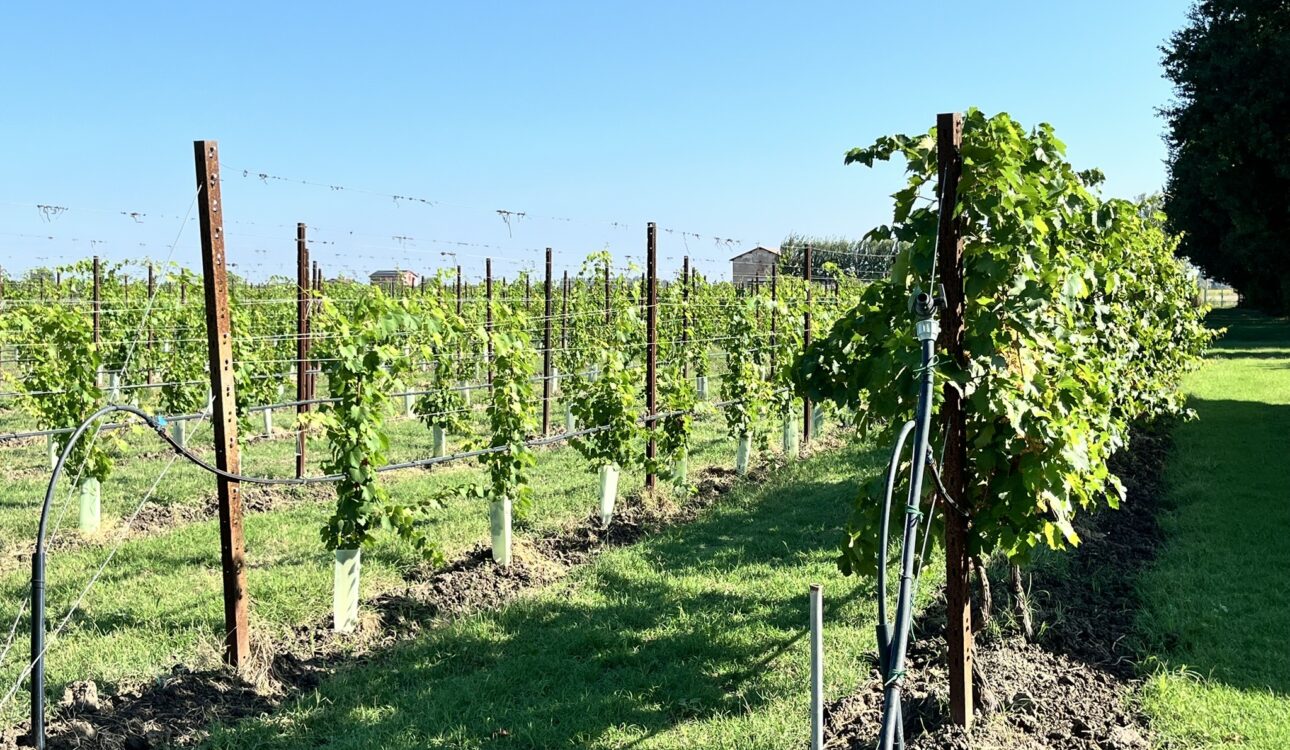
Pruning techniques vary depending on the training system. At Acetaia, two types of training systems coexist: espalier and GDC (double curtain), with different pruning systems: the former for renewal (Guyot or double inverted) and the latter using spurs on a permanent cordon (GDC Geneve Double Courtain double curtain).
In the first case, it involves removing all branches except the existing, most vigorous one, which represents the oldest part of the plant. It is therefore a “long” pruning, “renewal” pruning, leaving well-wooded, medium-sized shoots with a high number of buds.
This type of pruning, once chosen for difficult terrain as well as for grape varieties with low basal fertility such as Lambrusco di Sorbara and “Trebbiano di Spagna”-Trebbianina, has recently also found great success in the fight against phytosanitary adversities thanks to a structure that is always young and vigorous with wood that, in unfortunate circumstances, hosts phytophagous insects for less than a year.Questa tipologia di potatura, un tempo scelta per terreni difficili oltre che per varietà di uve con bassa fertilità basale come il Lambrusco di Sorbara e il “Trebbiano di Spagna”-Trebbianina, ultimamente trova gran riscontro anche nella lotta alle avversità fitosanitarie grazie ad una struttura sempre giovane e vigorosa con un legno che, nella malaugurata sorte, ospita fitofagie per nemmeno un anno.
The GDC system, on the other hand, was originally developed to achieve maximum automation where the vigor and physical conformation of the land allowed. It features a solid and complex system to manage two curtains suspended from permanent shoots that run parallel to the axis of the row. Pruning is described as “short,” with several spurs each containing a few buds.
Regardless of the type of pruning and training, it is very important to measure the amount of buds left on each plant, which affects the number of bunches obtainable and, above all, their quality.
This choice, conditioned by the fertility of the soil and the vigour of the plants, determines the quality/quantity ratio.
Ultimately, given that we are in a natural setting, we can say that every plant, every vine has its own story, and it is essential to understand its needs and care for it to ensure we have the opportunity to enjoy its extraordinary fruits every year.