Once the grapes have been pressed and the must we need has been obtained from the bunches of grapes collected during the harvest, we store the must for a day or two in large refrigerated tanks to prevent it from fermenting and becoming wine and to facilitate its natural clarification through decantation.
In fact, before it turns into wine, the must must be cooked; in this way the sugars increase (from around 17/20 up to 27/28° babo) by concentration thanks to the evaporation of the water it contains.
Subsequently, natural fermentation will produce not a “simple dry wine”, but an alcoholic must rich in sugars which is the essential basis for the subsequent acetification and for the maturation and aging processes of the balsamic vinegar.
From Roman evidence we know that the practice of cooking must was already known in 30 BC. Virgil, in fact, wrote “meanwhile the wife, consoling herself with song during the long work, passes through the weft with the sharp shuttle (= weaves the cloth), or cooks with Vulcan (= with fire) the sweet juice of the must and foams the surface of the boiling cauldron with leaves.
Columella himself, commenting on Virgil’s “Historia Naturae”, said that such musts used to turn into vinegar (“solet acescere”) even after cooking.
Why is must cooked?
First of all, cooking increases the percentage of sugar, mainly glucose and fructose, due to the evaporation of water.
Furthermore, when cooked over direct heat, the sugars undergo a slight caramelization effect, which is the precursor to some of the organoleptic characteristics of Traditional Balsamic Vinegar (it is not for nothing that the industrial product is added with E150 caramel).
Secondly, cooking pasteurizes the must, so that the subsequent fermentation will be guided not by the “indigenous” yeasts of the season, but by yeasts selected over the years and “resident” in the Acetaia’s environments.
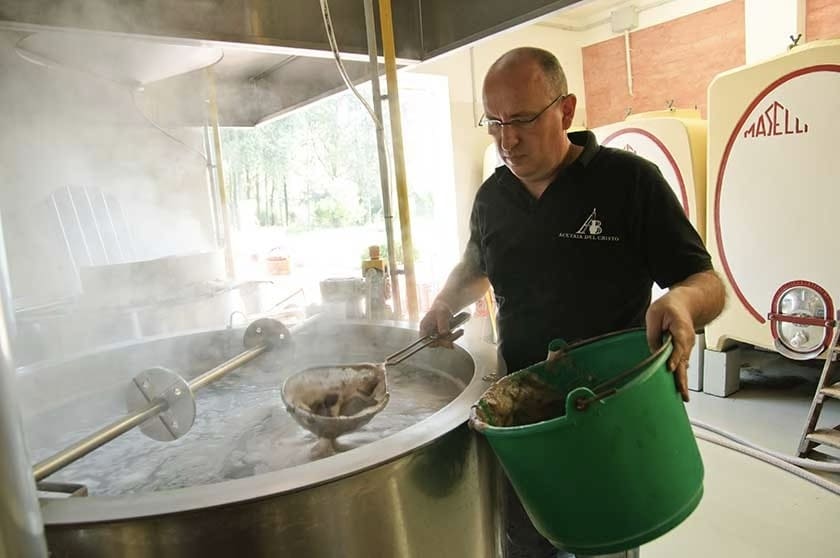
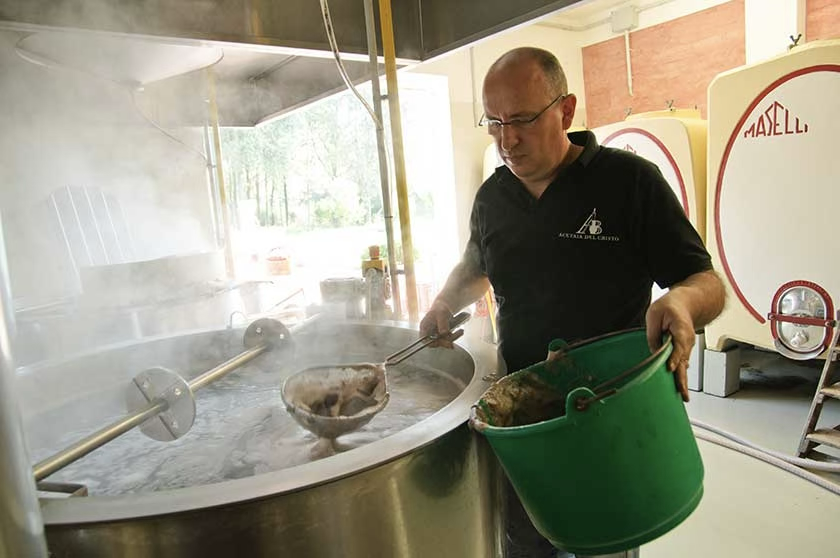
And as happened with Virgil’s wife, here too, in the vinegar factory, when we bring the must to a boil, we wait until a dense foam forms on the surface of the must, which we remove with a special mesh. This allows us to ensure the greatest cleanliness and purity of the must, already achieved through cold decantation.